Dorothy
The tweet I put out on the night of watching this film:
“A showy but more evolved Subbaraj, in spite of some familiar missteps. This time the writing - for most parts - makes it easier to feel with his wild swings as much as think about them. And I currently think his oeuvre might carry more heft than his individual outings.”
For the lack of an idea to start this piece of my scattered thoughts, let me start by explaining this tweet and build on from there. Spoilers ahead.
- Why am I saying “showy”? It’s because a lot of times, I have felt Karthik Subbaraj’s ideas to be complex in their aesthetic than their psychological depth. There’s always been a leaning towards the visuals of his thesis over the idea and depth of the thesis itself. So much flair in creating a quirky, stylish world to contain an ideology, but then somewhere towards the end, the idea behind it all is explained away in a verbose fashion (Jagame Thandhiram, Mahaan). Iraivi is the closest he last came to balancing his filmy idiosyncrasies. It’s been difficult for me to like an entire film of his since then. But I do entirely trust that he’s sincere at heart, which in itself makes it easy to root for his oeuvre.
- There’s some more showiness in moments like the insect in frame as three grown men have a futile fist fight in an empty patch of farmland. The score can also be seen as one aspect of showiness - my most controversial thought on this film. While I truly liked the era-adjacent soundscape, and the gravitas of the score - there were also moments when I felt like it’s there to show-off, which I see as more of a direction problem. KS relies rather heavily on Raaja’s brilliance that it could even distract you from the emotional heft of the moment. Achieving some seamlessness there probably needs a more mature filmmaker. I do see a counter for this as well - what’s wrong in reusing a track familiar to our audiences, in a moment that probably wants to allude to home being a person, rather than a place?
- Why “a more evolved” Subbaraj? There’s a sharper flow to the events in this film. The focus doesn’t waver, thematically. It feels more coherent. A study on a patriarchal atmosphere, goes through a metamorphosis to dismantle and challenge that system in a deeply personal story of sexuality. The two halves in this way aren’t as jumpy as ideas - unlike say a “Tamil gangster in London” that travels into genocide. But I also don’t want to entirely shoot down KS’s attempts to weave in whacky extremes into single films - I just believe he can write them better, more coherently.
- Dorothy isn’t spotless with its coherence - there are places where character development feels like it’s happening to progress plot rather than feeling like the result of a gradual change. Take for example, Karthi’s arc in the second half. His frustration with his own situation feels stagnant, like it’s being stretched to a point of feeling repetitive, before finally arriving at his (arguably predictable) decision to spare Subbu.
- For a film that’s talking about something so important to the human condition - identity and dignity, the want for it to have been more right is palpable. I did wish the violence in the initial half could’ve done with sensitivity - more suggestion than blatant showcases. I really wish for the women to have had slightly fuller characters. What did Dorothy like in Subbu’s brother? Writing 2 more lines for Dhanam as a person, revealing her thoughts or character, wouldn’t have come in the way for that eventual reveal. Why not make these women real people? Why do they have to be angels, dolls, or “iraivi”? I hope someday Karthik sees the fallacy in placing them on a pedestal to understand them - I believe they’d be wanting to be seen as equals rather than be solely revered as higher beings?
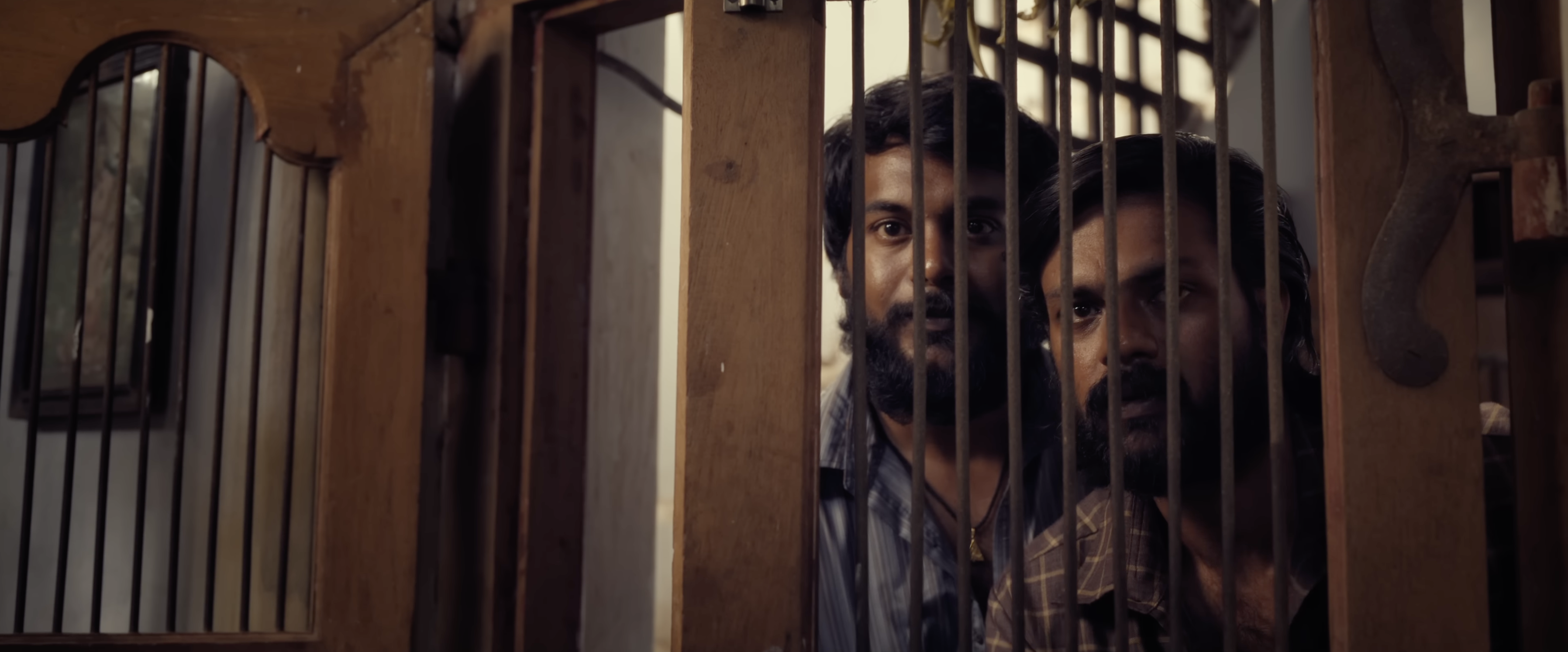
- But the writing in the first half - especially with Karthi and Subbu’s friendship - is established pretty neatly. The friendship primarily only comes across at a cerebral level due to cinematic devices (parallel imagery, mirrors, callbacks) before actually being an emotionally affecting one. But eventually Rishikanth’s truly endearing performance and the passage of time with the characters does make it easier to feel for them. Sananth is good too, in a pretty challenging role that takes a very sharp turn, one that could’ve done with some subtle care in the way KS renders her, to make the acting feel more grounded and in-sync with the character as a person first, rather than as a concept? I’m curious to read more trans and queer perspectives on this, if the treatment came across as stereotypical, etc.
- I could enjoy and feel for the wild swings in the second half because of how far Subbaraj wants to take his thesis of acceptance. His familiar twisty-ness is less brains and more heart this time around. A big improvement from his Mahaan days. Closer to the heart I sensed back in Jigarthanda - except in here we’re working with a more complex world, worldview, and beings. I still would love for him to do a couple more drafts of his screenplays before filming.
- Subbaraj is solid and flashy with his craft in setting up a world, or even setting up conflicts, but when it comes to conveying the extents of his own compassion, he becomes a lesser filmmaker, resorting to lesser and more hurried devices. Imagine designing Karthi’s travels in a way to help him see more (people and nature), instead of being helped by Dorothy’s words alone? Or how about we spend some more time on Karthi’s internal workings, after parting ways with Subbu, could that have made his final journey more affecting for the heart than for the mind? Spending less time on “will he do it?” (the dead body twist is also a tad predictable) could’ve made a lot more space for the arc towards love. Ilaiyaraaja pitches in with the brilliant Muthumani - a track so good, the visuals seem timid and one-note for its sonic colours and lyrical magic. The brief for this sequence could’ve done with more ethereal and poised flair, rather than just being trippy.
- I also wonder if anything less than the final frame we currently have, would’ve worked against the film? Because the entire first half is spent on deploying visuals of disturbing violence, which is a rather obvious aspect to criticise the film with. So we’d probably be only left with one way to counter it in the latter half - to pose a counterculture of sorts, to celebrate love to an extent that has clearly eluded Tamil screens and the imagination of Tamil filmmakers and audience alike. It’s a truly special stroke, and has the potential to stand the test of time for its radicalism, even if not for cinematic merit.
Now here’s a tweet I’d put out regarding Mahaan, 4 years ago -
“Doesn't push beyond ideas. The characters, the cyclical narrative, the conflict. All of them are potent ideas, but aren't fleshed out enough to inspire an emotional reaction. Subbaraj tries a lot to impress the mind, but I feel he also needs to go after the heart.”
Now with Dorothy, he’s clearly gone after the heart, and with a respectable swing at it. I’m happy about this, but also greedy for more and better.